Post 5: Progress Report for Personal Learning Plan

There are two methods of assessments that occur during the teaching & learning process which defines the relationship between a teacher and a student. These methods are called Formative Assessment, and Summative Assessment. In Formative Assessment, a teacher provides the student with learning material in the form of a lecture, reading, quiz, or assignment. The student is assessed in their progress by way of a low stakes assessment such as a quiz for little to no marks, so that pressure is off of the student to do well just for the sake of getting a high mark and potentially failing the course in an all-or-nothing examination. Such a method of teaching is, in my opinion, not conducive to learning, and in fact it can become a hindrance to progress.

A self-guided learning endeavor, such as a personal learning plan to teach oneself coin magic, cooking, or riding a unicycle, certainly involves low stakes assessments. As somebody sets out to teach themselves a skill, they self monitor their own progress and hopefully adjust their technique in order to maintain that progress. Somebody provides feedback to themselves in this case. It would seem that personal learning plans naturally utilize the formative assessment model. The stakes are only as low or high as the pressure one puts on oneself to do well or not.

However, it would seem that I did not employ the model well enough over the course of the past 5 weeks. My skills in coin magic have not progressed to the point that I would like them to. I feel that physical manipulation skills such as this require more dedication than I was able to muster. It would be interesting to see how my skills would have progressed under the guidance of a master magician who monitored my progress and provided me with tasks or “assignments” to complete in addition to demonstrations. It’s possible that self guided learning, while resembling formative assessment in a formal learning setting is no replacement for the teacher-student style of learning.

Summative Assessment is the kind of learning that is quite prevalent in many large classroom or lecture hall settings. With hundreds of students, it’s difficult for a teacher to provide individual students with meaningful feedback. Therefore, the student is expected to learn all of the material and, at a testing milestone, be able to perform up to a specific standard. This is the hallmark of many university experiences and, in my opinion, creates an atmosphere of tension and stress that does not lend itself to learning effectively. In my experience, concepts are learned and quickly forgotten under this model. Indeed, it would seem that all-or-nothing high stakes testing only tests a students ability to memorize quickly, but it leaves something to be desired: a strong foundation of learning built upon practice testing, spaced repetition, and interleaved practice. Practice testing can be observed in the formative testing model. Spaced repetition is inherently supplementary to a good formative model, since the continuous loop of practice testing (self or teacher assessment) and adjustment of studying habits based on student progress provides a natural interval of learning, focused studying, then a low stakes quiz, would result in better long term retention.

However, high stakes testing does have it’s place, especially when it comes to university degrees where the credential should have weight and reputation. It would seem that a healthy mixture of the two methods (formative and summative) are the best way to teach and learn. Summative assessments shouldn’t be done unless a good teaching style is employed under the formative method. I have had experiences during my time learning computer science with specific professors who seemed to pride themselves in failing at least half the class, and even made utterances to that effect. My learning experience in this case was to study as hard as possible, under a lot of stress (and admittedly angrily), just to prove that I could pass such a course. Since that course, I have forgotten many of the concepts. By contrast, my best learning experiences of even more complex topics (compared to the course just described), have been where teachers utilized a combination of the formative and summative models. I remember many of the concepts from those best courses years later. The worst ones were taken within the past year and I believe I have retained less than 25%.

In my experience with both horrible classes and great classes, the best professors had weekly low stakes tests, small achievable assignments multiple times a week, and were available for feedback and/or tutorials during office hours. In addition, I found that professors such as these made learning even complex material a lot less scary because they were sympathetic with how difficult the material was, and even acknowledged that they wanted to prepare us for mandatory final exams as much as they could. By contrast the worst professors made the learning environment tense, competitive, and elite. That is, only the best should be doing this degree and the rest of you should just do something else. Granted, not everyone completing any degree will continue down that career path, but anyone who endeavors to learn complex material over a four year period should be enabled to do so, not faced with artificial seemingly malevolent roadblocks.

EDCI 335 Peer Review of Interactive Learning Resource

The following post is in regards to an Interactive Learning Resource, Augmented Reality Application with Unity and Vuforia, being peer reviewed be me in fulfillment of the requirements of the EDCI 335 course at the University of Victoria, Summer 2019 semester.

I noted the use of Google Slides which is a nice use of technology. Google Slides has great functionality with a simple user interface and beautiful default aesthetics. In terms of content sharing and group collaborative efforts, Google’s suite of SAAS (software as a service) is amongst the top available and a great choice. It’s also nice to see that the team required it’s learners to install and configure software, which is the utilization of technology from the teams perspective since they’re both utilizing and demonstrating it, but also encouraging users to potentially step outside of their comfort zone and use the technology for themselves.

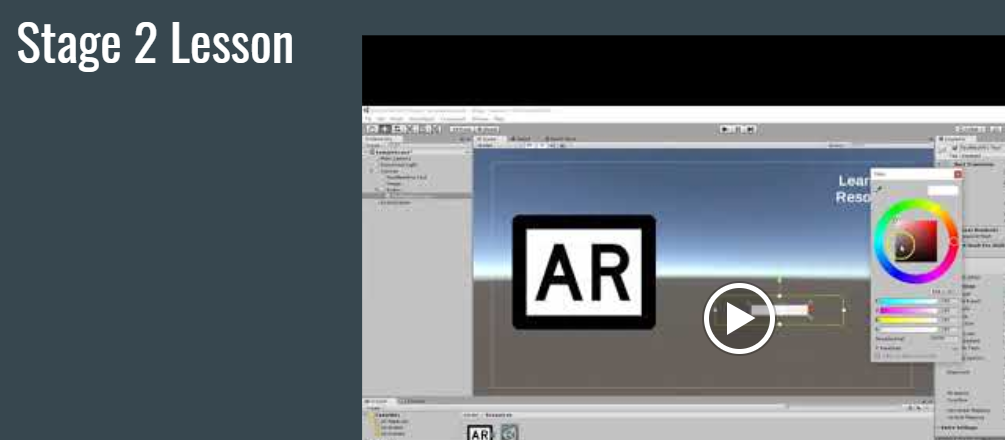
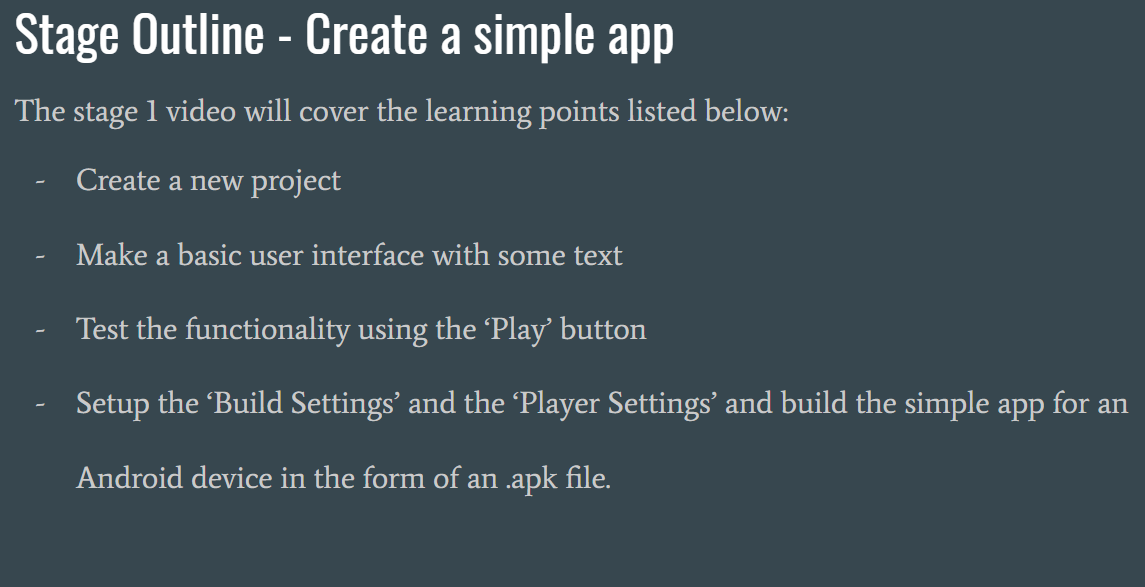
It’s nice that the learning outcomes for each section are stated at the beginning of each section slide. An embedded tutorial video is one of the first things that a learner encounters in the slide content titled “Stage 1”. The video content is directly related, and helps to fulfill the learning outcomes for that section which were explicitly stated (in part) as: creating a project, making a basic user interface, and testing the functionality of the application.

Example of course outline prior to each section. Image credit of Mumin, Nagpal, Liu, Reese (2019).
Example of embedded video content within slides. Image credit of Mumin, Nagpal, Liu, Reese (2019).

One small criticism at this point, not specifically about the videos, is that, prior to engaging with the sections, I am unsure of what kinds of prior knowledge this tutorial expects the learner to have or what the course outline is. I’m not sure if the requirements of the project explicitly stated that this is required, but I do find them handy (kind of like a course syllabus). However, we are adult professionals taking a university course so we are expected some level of proficiency, especially with technology, but it would be helpful to activate that part of my brains learning center by having a slide explicitly outlining something like:

Learning Objectives
A learner in this course will create an interactive augmented reality application (etc)

Prior Knowledge
A learner is expected to be comfortable with installation and use of intermediate level software creation applications (Unity) (etc)

Course Outline
This course is broken up into 5 stages. In each stage you will learn the following:

Stage 1: Install and set up Unity, and create a simple Android application
Stage 2: Make your Android application interactive
Stage 3: …etc

However, in watching the video in section 1, the video alleviates concerns about prior knowledge and the fact that we’re using a fairly advanced software application since the narrator is very well spoken, and clear in his articulation and meaning, making use of the program a breeze. In my experience with intermediate or advanced development environments, video tutorials are a godsend, and this one is similar in that regard. I was able to follow the directions of the video which had little to no ambiguity at all.

After watching more videos I began to recognize that the embedded video content is central to the Interactive Learning Resource. The slides are simply a guide to the videos, which are the key components of the lesson. So, if the learning resource itself was JUST a video, or series of videos, absent of any slides to guide it, then I believe that the learning resource nearly fully meets the requirements of this assignment, and that the slides themselves are a bonus. However, I maintain that the course outline & overall learning outcomes should be present, either in the slides, or as a separate video module which accomplishes the same task.

At first glance during a perusal through the slides, I noticed that the presentation was well laid out and appealing to the eye. In addition, the slides themselves were well organized and never cluttered. Essentially, the presentation of the content was done quite well. I never got the feeling quite common in many other learning resources where I thought to myself “great another wall of text”. It’s refreshing to see a minimalist presentation which can lend itself to a better learning outcome since I won’t find myself skimming over large swaths of material just to get through the content. It seems that the content that is present is worth reading, and it can be read quickly. It’s to the point, which is desirable in my humble opinion.

I found that the lesson was very well planned and executed. I was able to follow the steps without any hiccups, and I found that I certainly learned something about Unity and Vuforia. The glossary was a very nice touch, and functioned as a quick reference guide. In addition, the links and helpful resources section was a nice touch. These sections also served as references to the software resources that were utilized and mentioned throughout the videos. Prior to watching this tutorial I was quite mystified about how augmented reality applications could actually be created. Granted, I never bothered to do research about it, but after utilizing this resource, any fears about getting into AR have been dealt with, and actually has piqued my interest.

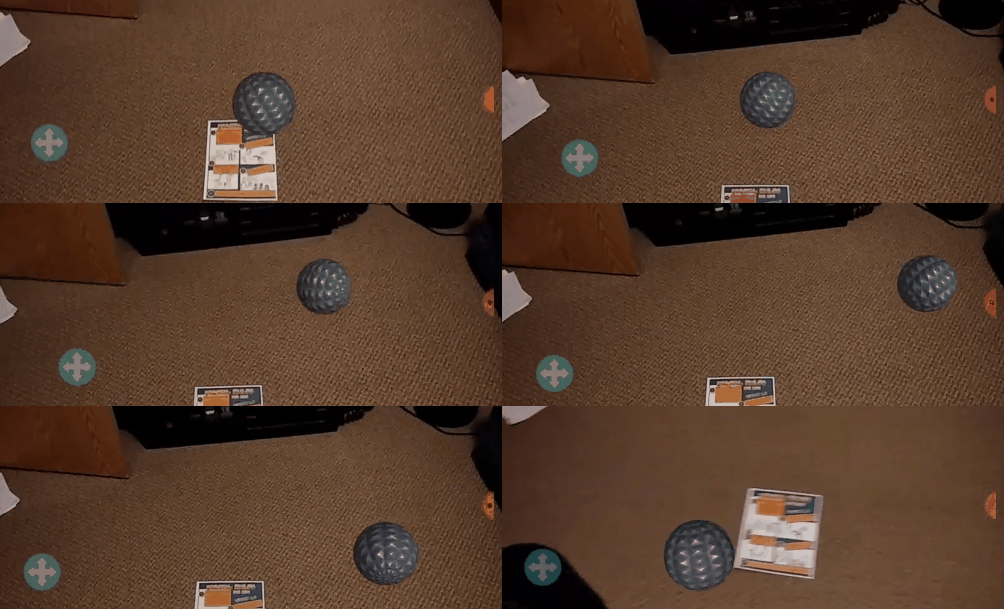
The resource was certainly interactive. Installation of the software, manipulation of all the settings and creation of content, including the use of my own images and textures to create a ball that could actually roll around in my living room was both enlightening and encouraging, since it sparked a sense of creativity and motivation to do something more customized (AR games come to mind).

Example of desired outcome, an AR ball. Image credit of Mumin, Nagpal, Liu, Reese (2019).

In terms of spelling and grammar, the slides themselves were done quite well with very few spelling or grammar errors. The narration in the videos were pleasant and easy to follow with nothing “cringeworthy” that comes to mind.

I enjoyed following the steps in the learning resource, and, if this resource was just one module of many, I think I would certainly continue to learn successfully in this way. Thanks to the team members: Noor Mumin, Rythm Nagpal, Jack Liu, and Tyler Reese for making a great learning resource. Please accept my review for your consideration.

Interactive Learning Resource

Please see the link (below) to access the interactive learning resource about “Demystifying Computer Science”.

In this course you’ll gain an overview of some of the fundamental ideas about what Computer Science is in the context of the history of computation, and some of the tools of the trade.

The course assumes that you’re an adult professional with no background in the computer science field. If you have a degree in this field, you might find the material a bit elementary.

I welcome any feedback on the resource including accuracy of information, suggestions, and tips.

Thanks.

Log in instructions

Please note that the account provided is a test account, so it is subject to use by many of your peers. The natural flow of the course would be such that each section and quiz must be completed before the remaining ones are unlocked. However, for testing purposes, all of the sections and quizzes are unlocked at the outset.

Use the following credentials…

Username: testuser03
Password: 12345

…to log in at https://dcs.moodlecloud.com/login/index.php

Post 4: Progress Report for Personal Learning Plan

I realized that I had to purchase the book to learn my chosen skill. I didn’t find much in the way of free online learning resources for coin magic. A free skill sharing medium would be great. Something like like a free SkillShare website would be perfect. Except, at first glance I didn’t notice anything as powerful or widely used as the paid version of SkillShare. This is where encouragement of FLOSS (Free/Libre Open Source Software) would come in handy. The advantage of FLOSS is that we do not have to trade our personal information in exchange for using software. I actually very much support the FLOSS movement. Open Source software is excellent. I am a frequent user of Linux, an open source operating system. Linux comes with many free tools such as Libre Office, an open source suite of office tools like word processors, spreadsheets, and presentations. This kind of software must be available in order to keep information free, and not solely to benefit a select few which just widens the gap between high class and lower-middle class people. If money wasn’t a thing (I’m thinking the universe of Star Trek), but rather personal achievement and the betterment of human-kind was the driving force, I wonder what kinds of FLOSS systems would be available. While I don’t support elite money making strategies of evil big box corporations in Silicon Valley, I do support some of their efforts to make premium software available to the average user (as I use Google Docs to write the draft for this post). However, one way to interpret their strategy might be that they’re trying to corner the marketplace. Let’s make everyone so dependent on this super great software, then we’ll add a subscription fee. That’s is one concern that I have. So I think the only way to go is to super promote the development and use of FLOSS systems.

The reading assignment this week, Chapters 6 and 7 got me thinking about how I could possibly improve the learning experience in teaching somebody else my chosen topic of the Interactive Learning Resource (Computer Science concepts), and the importance of focusing more on the content, rather than the technology afforded to me. Given that the six key building blocks of media are face-to-face teaching, text, graphics, audio, video, and computing (simulation, animation, virtual reality) what are some of the ways that I could improve my own Learning Resource?

In addition, I found that there aren’t many great learning resources aside from books, or poorly made videos to teach people coin magic. Actually, I think a great learning resource might also be a magic skills website. Not just for coin magic, but maybe one for magic in general. This kind of website would need to be staffed all the time in order to maintain that face-to-face aspect of the six key building blocks, but the other building blocks could be easily integrated (maybe).

A site like this is possible, but the content would have to populated by single expert in all domains of magic tricks, or by a team of contributors all with varying skill sets. Another possibility is almost like an open source skill contribution system similar to the SkillShare model. According to Wikipedia: Skillshare is an online learning community for people who want to learn from educational videos. The courses, which are not accredited, are available through subscription. The majority of courses focus on interaction rather than lecturing, with the primary goal of learning by completing a project.

It’s interesting to think about the pedagogical differences between content that one could present on a learning resource, or how that content is delivered by a site that you’re learning from. I never really considered that one might be better than the other for different types of information. For example, text is better for abstract information, but video animation with narration would be great for presenting concrete examples of abstract concepts. Learning coin magic is very much built on concrete examples. Describing the step by step methods for even simple tricks in text can be hard to consume. I find myself straining to visualize the steps as I read the text, and even slowly manipulating the coin in my hand, or moving my hand without a coin as if I was actually doing the trick. Effectively, what I’m doing is showing myself a concrete example by reading the more abstract descriptions in the text. Granted, the descriptions of the manipulations aren’t themselves abstract, but the letters and words that represent the individual actions are abstract representations of the ideas therein. I think a much better method to deliver such content would be animations with narration, or an instructor with narration. However, when the book was originally published, easily accessible video and audio media did not exist! It was published in 1952. Yes there were televisions and movies, but home video systems weren’t available until the 1970s with the invention of the U-Matic, VHS, and Betamax systems.

If one wants to learn magic at home these days, of course books are available, including older ones like J.B. Bobo’s Modern Coin Magic, but in addition there are many more resources afforded to us by the advent of FLOSS based resources, which of course is prevalent because of high speed internet and the evolution of interconnected resource sharing in general. This actually is quite amazing; to have these kinds learning resources available to us at our fingertips shouldn’t be taken for granted. Now all we need is the discipline to go ahead and learn these things! It’s easy to fall down a YouTube rabbit hole and never get anything done. I suppose that’s why gamification in learning resources comes in handy. If we’re like rats in a cage, and scientists are testing our dopamine response to consume food pellets or addictive narcotics by hitting buttons for delivery of either (and to see what we choose more), instead of food pellets or narcotics we’re hitting buttons for junk-food media (YouTube, Reddit, etc) or something educationally useful that we should be doing instead. Sometimes it feels like a losing battle.

My current learning plan progress hasn’t been progressing as well as I would hope. I feel that I’m starting to plateau in my level of skill. There are mental roadblocks to both motivation to practice a lot, and when I do practice I feel that I’m not making any progress. It’s actually quite frustrating. However, I know that this is the difference between an amateur and a master practitioner of any skill. So instead of motivation, I need to push harder in the face of frustration. I need to exercise discipline. The reality is that I’m definitely making progress, but it doesn’t feel like it. It’s just that the kind of progress I’m making now is is less noticeable than it was in the first few days. Kind of a logarithmic graph of progress. Now I’m fine turning the movements, or developing more of an instinctual feel for the manipulations of the coins and the nuances of the tricks that I never realized before.

Post 3: Progress Report for Personal Learning Plan

Deep Learning vs. Surface Learning

It occurred to me while I was practicing various coin tricks that there is no possible way that these movements could be learned by studying theory alone. For some skills, surface learning is not always possible. As an example, to pass a coin magic test, a bare bones demonstration of the manipulations based purely on memory would not suffice. Even if your test were just to demonstrate deliberate movements to a master magician, but not at a level of proficiency to fool even an inexperienced observer of magic, but rather to show that you had been practicing (doing the thing), and all you had done was cram the theory in the night before, you would fail miserably. The slow, deliberate, mechanical movements that might be required for such a test would not even be possible by knowing just the theory by memorization alone. Some skills require doing, plain and simple.

Then I started to think about other learning experiences that do not involve physical manipulation, yet still require the same level of dedication to doing in order to pass a test. Something that I learned very early on in my academic career was that some skills require doing in order to even pass the class, let alone do well in any sense. For example, in my Math 101 class (Calculus 2), the failure rate was 50%. Half of the students taking the class were taking it for a second time. Yes, there are gifted mathematically minded students who think that math is a breeze, and they never really had to try very hard. However, for the average person, the only possible way to pass classes like that are to do problems ad nauseam; to spend literally four hours per day, nearly every day for the whole semester was the only way to get a good mark at this class (unless you were one of the gifted few). So, learning by doing isn’t a requirement to learn only physical manipulation skills. Some subjects require a deep understanding in order to even pass the class.

Many teachers of these subjects simply present the material, expecting that their students will pass the course or they won’t, and that’s the students responsibility. In a course similar to Math 101, Linear Algebra was another tough course (at least for me). I remember going to office hours where my professor refused to show me an example of how to go through a sample question, stating that I would just memorize the steps in order to complete similar questions in the future. I got the distinct impression that this professor did not care about how his students did. According to John Biggs, who created the SOLO (Structure of the Observed Learning Outcome) Taxonomy, the highest “level” of teacher are the ones who care about how students do during and after the lecture material, and establish outcomes of learning for the course, and encourage engagement with the material. Clearly, this was an example of poor teaching practice.

If I was to be a a level 3 teacher, one who cared about how students did during and prior to a lecture, and I was my own student, how could I teach myself to be a better coin magician? First off, I would establish a set of learning goals: by the end of this learning experience I would like to be able to demonstrate a convincing display of five magic tricks: the standard vanish, the tunnel vanish, the back clip vanish, the smart vanish, and the King Midas. Next, I would assess myself at the end of a certain interval. This assessment might be well served if it was defined in terms of the SOLO taxonomy.

How might a SOLO taxonomy look for a coin magician marking rubric? Lets take a stab at it. The SOLO has five levels of understanding and, according to Wikipedia, the five levels are defined follows.

  1. Pre-structural: The task is not attacked appropriately; the student hasn’t really understood the point and uses too simple a way of going about it.
  2. Uni-structural: The student’s response only focuses on one relevant aspect.
  3. Multi-structural: The student’s response focuses on several relevant aspects but they are treated independently and additively. Assessment of this level is primarily quantitative.
  4. Relational: The different aspects have become integrated into a coherent whole. This level is what is normally meant by an adequate understanding of some topic.
  5. Extended abstract: The previous integrated whole may be conceptualized at a higher level of abstraction and generalized to a new topic or area.

Assume the following are potential statements from the perspective of a teacher of coin magic making an assessment on one of their students demonstrations of learned material:

  1. Pre-structrual: The student simply holds the coin between his right hand pointer and index fingers, grasps the coin with the left hand and makes no effort to hide the palming of the coin in the right, then opens the left hand showing that the coin is not there, but clearly there is no illusion.
  2. Uni-structural: The student demonstrates all of the steps of the required illusions poorly except for the palming aspect in each illusion. It is clear that the student has focused on only one aspect.
  3. Multi-structural: The student demonstrates proficiency in each of the components of the illusions, but flow between each is poorly done, mechanical, and obvious.
  4. Relational: The student demonstrates the required illusions in a convincing way, each step flows naturally to the next. The student shows promise.
  5. Extended Abstract: The student demonstrates the required illusions in a natural, convincing way, but goes beyond the requirements of the assessment, narrating each step while they go through the demonstration, simultaneously discussing how each movement component could be utilized for other illusions, improved upon, or which ones are weaker.

To be good teacher to myself, by establishing learning goals in terms of the SOLO taxonomy, I am demonstrating constructive alignment. Good teaching gets students to use their higher level cognitive processing (evaluating, assessing, critiquing) instead of simply memorizing (like in surface learning). The goal is to make a surface learner behave like a deep learner by engaging with their material. To learn we must do the thing, whatever that might be.

This weeks progress

I established that each trick would be practiced 50 times over the course of a week. Completing the practice this week took dedication, and made my hands sore. Not only that, but I was forced to endure what seemed like endless dropping and retrieval of coins. This was certainly an exercise in patience. It would seem that self-assessment by utilizing the SOLO taxonomy in a way that I outlined above could be an exercise in futility, since I am biased of my own skills, and I am not an authority in the area of coin tricks. However, even if I cannot assess myself according to SOLO, I can employ the other aspects of deep learning simply by establishing learning goals in terms of SOLO, and keeping myself engaged with the learning task at hand.

Featured image by Krika99 at Flikr
https://www.flickr.com/photos/48499944@N03/14634917023